Have you ever wondered how am I going to get through teaching energy?! I have been there! This seemed like the toughest concept that I saved to teach last to my 5th graders! I had trouble understanding the level of material myself...while I can't fully help with that I can show you what did work and really engaged my students as well!
For each section we studied, I used these Science Solver cards! Essentially task cards that took our study to a whole new level - let me tell you why.
Since I'm not in a school this year I have still been involved with kids even in my community. Recently I held a slime science event at a local community center for parents to drop off kids and shop/wrap presents if need be. We had four different slime stations and lots of learning and fun took place.
I loved that kids wanted to come outside of school and I tried to provide some great extensions about science from what they are learning. The stations we had were:
Magnetic Slime
Color Changing Slime
Glow in the Dark Slime
DIY Slime
I wanted this to extend education in addition to the clear fun of "slime" on its own. I made a specific booklet that contains all the recipes that we used and activities that go along with each type.
For our specific event, we had kids rotate around in groups and really didn't get to do too much of the book work, but the table leaders went into specific details and experimented after making it.
The way our event worked was 2 rotations of slime, then we met, talked and had snack, then finished up our last 2 rotations. At the end, we met back up and looked at our books to find something new we learned or write it down and that is what they shared before they left.
Overall, this would make a great family night for your school. Buying the supplies in bulk really cuts the cost of the event. We used 2oz cups since they got to take home 4 different types and that worked out great. The booklet even comes with a whole page of parent extensions!
My four favorite parts:
1. My Pearly Snow Slime:
Guys I seriously could not stop playing with my own slime I made. At the DIY station I used White Pearl Paint combined with sequins to make a winter-y pearl paint. I loved the shimmer and shine but it wasn't too much and the consistency came out just right. We learned no matter how many times we made it that consistency varied each time it seemed like - too loose, too tight or just right. It took lots of trial and error - we used pipettes to drop in the Borax solution to make sure we weren't adding too much. Watering down the glue helps as well.
2. Magnet Fights
Because we used Iron Filings and Iron Oxide in different batches we could test the strength of each. Below is a video of the two different types and how they interacted with Neodymium Magnets .
*yes those magnets have to be used - I noted that in parent materials*
Pulling back the slime reveals the magnetic field!🤓🤓🤓
Also what's really cool is that those two slimes become magnetic to each other after polarized with the magnet. If they are stored near each other the iron fillings will all gravitate towards the iron oxide slime - PRETTY COOL!
The color changing slime was so fun to make and experiment with! Thermochromic pigment makes this slime so special. The pigment changes color with different temperatures! I could not find one to purchase that changes at a lower temp. Ours changes at 88 degrees Fahrenheit which actually worked out well.
We could dip it in hot tap water, warm with our breath, stretch out warm slime and watch it cool, and get metal utensils warm to make patterns!
The cool science part was letting students use a thermometer to experiment with exactly what temperature changed the slime. Lots of trial and error to figure it out. The powder can be a little pricey but woukd easily make a big batch for one class!!
4. “Literal” lightbulb moments
The glow slime was really eye opening for some of the kids that have never seen black lights or used them before. It was so cool to see their reactions to he parts. Clear Glue works better than white glue for glow slime!
We used Highlighter ink in our water since it glows in black lights, we used glow paint and black light paint to make sure our slime glowed in dark and under black light really well. I made sure kids got to see each part of that process as well!
If you are interested in the workbook that goes with the materials to use in school or for parents you can find more information by clicking here or any of the pictures below. It also comes with an editable invite and some promo resources!
My students loved this experiment and it could be used for a variety of principles. We used it while talking about separating mixtures using magnetism.
It could easily be tied to elements, compounds, mixtures and solutions (and separating them) or even digesting food and how the body needs and processes iron!
The video was how I introduced the experiment - more for the procedure aspect so they knew how to swirl properly.
We tried different cereals we brought in and made hypothesis based on the amount of iron listed on the box. Obviously iron fortified cereals work well but shredded wheat was our #1 so it was pretty interesting.
Here are some of the cereals we tried:
After adding the water - here's what it looked like. We talked about why the water was needed and what it helped the mixture do.
Trying to find Iron! Using magnet wands!
They loved this part - we were only able to find iron in certain cereals that had 50% more of daily iron intake but still a great lesson and fun to use cereals we had!
It is SO HARD to see but scroll down to see one of our best pictures! Even though we didn't find a ton it was clearly iron and following the magnet- from our cereal!!
I love how the papers we used (linked earlier) had a great explanation of how and why our body uses iron! this was a really fun learning experience that my students got a lot out of!
I am loving transforming my classroom to enhance student learning! It has been such a creative outlet for me as well as my kiddos! I want to share some reasons why these learning events are so fun and how they are tied to content.
1. Plan around what your kids love! Mario, Pokemon? Plan a video game day with different levels tied to "content skills." We did this already this year and students went absolutely GA-GA for it! They had to save Princess Peach and raise the flag. We got temporary tattoos as prizes. Easy and cheap but unforgettable!
2. Take one subject to the EXTREME! Last year we had "Grammar Surgery" that focused on 9 different skills we had worked on throughout the year. The "heavy hitters" for our grade level. We had supplies donated and it hardly cost anything to put together plus I'll have it all ready for this year!
now tell me that's not going to stick with them forever!
3. Builds Anticipation - Learning is Fun! Students cannot wait once they see me start to put things together or any sign that says they have to wait. Sometimes it's weeks in advance that I lay clues. They are always dying and so excited to come into class. Can you remember that feeling from school? Even if it is only a couple times year (because hey these do take some planning!) they will remember THOSE experiences all tied to content. Usually mine are planned around reviewing skills not teaching anything new but still so valuable....especially before testing.
This was from our Awesome Cave Day - which coincides great with Missouri history!
Stretchy headbands with touch lights attached - they were on sale at Walmart. We live in a hunting community so headlights borrowed from students was possible as well.
4. Extend learning to places not thought possible!
After reading the BFG we extended our learning by drinking Frobscottle (which causes farts in the book) and reading articles that discussed why we fart/burp tying in some science. We then had a mission from the CIA to create lunch menus (health) that would have students producing "less gas in class" it sounds hilarious but boy did they take it seriously when working for the CIA.
I had a fingerprint scanner app (that didn't do anything but looked cool) they had to do that before we started work so CIA could keep tabs.
They had to write official letters (writing, parts of a letter) back to the CIA with their specific menu and reasoning for choices based on what they read - talk about deep meaning of a text and APPLYING it to a real world (albeit funny) situation. UNFORGETTABLE!!
The key to this being successful is organization! I worked on this weeks in advance just little by little to make it exactly what I wanted. My parents donated bandanas for each team (from Hobby Lobby only 99 cents or cheaper with coupons!)
I made each team a rotation schedule that they would do the stations in. I had ONE GIANT PROBLEM! I had 11 groups of 2 and only 7 stations. Hmmmm.... what could the others be working on ....I get to that later!
First I went through and explained all the stations. In my teacher dreams, I'd have these located around school with poems or clues to each - in reality I didn't get a chance to book rooms and didn't want to deal with weather so we had it all in my room, marked with letters. Boring but efficient. They have been looking forward to it for weeks so I know this was ok.
I also would have loved not having to go over all the directions before and have them read and figure out what to do, but short on help it was necessary so I didn't have to answer every single "What do I do?"
so let me explain the stations to you and where they went in between.
Station 2: USA Map Floor Puzzle Students had to complete a US puzzle and then list the first 5 capitals in alphabetical order. We start this right after Christmas so this was like an intro to it. We've been slowing working this in with our postcard exchange as well. ***Note*** 3 groups could do this one at once
Station 3: Rebus clue to Nonfiction book This picture puzzle (just like in Escape from Mr. Lemoncello's Library - our first read aloud) led them to our library where they had a "Road Block" they must read one of the 4 nonfiction books about creepy, crawly, undersea animals and get a 90% above on a comprehension quiz to move on. **4 groups could do at once** they had to show me scores for initials and to move on. (People who don't like AR hide your eyes!!!!)
Station 4: Parts of Speech Mad Lib I modified a Mad Lib just found from the internet ( a great one for this time of year would be from my Poultry Parts of Speech though!) I blew it up left blanks for the words. In a baggie, I laminated some cardstock with the numbers and part of speech that they need to fill in and then add to the Mad Lib with velcro. They will take a video for Seesaw reading it when finished for completion. Only 1 group did this at a time. You could easily use a book like Best of Mad Libs
Station 5: Math "Detour" Students have 2 paths they could choose to take. Each had 5 problems they had to solve using tougher concepts they had learned so far this year. Numbers 2 and 5 from each column matched and opened the lock box so they could do on their next clue. Only 1 group could do at a time and I had to make sure they remixed the numbers for the next people. It was easy to check and move on.
Station 6: Nonfiction Article Comprehension I got an article from the "Missouri" section of Newsela at a 5th grade reading level to challenge us. Students had to read and complete the 4 tough questions regarding the article before moving on. I did have a parent volunteer check this one and tell them which ones needed to be fixed before moving on. If they attempted 3 times that was the score they received - or you could put a time deduction because I really wanted them to focus their efforts on correct questions not just rushing. Up to 4 teams could be doing this, checking answers could get a little rushed.
Station 7: American Symbols
We touched on this at the beginning of the year and it was brief so I wanted a little review. I made a page and pictures with clues. The underlined "red" letters make up a word that unlocks the spelling lock indicating they got it right. Only 1 team at a time can do this.
Logistics:
We played Theme music in the background and I had a timer going on the board to record times after all 7 stations were complete. They did know that extra prizes were involved for not just speed but other essential teamwork skills.
Each team got their own colored bandanas (we took team pictures a couple weeks before) and they worked with those partners anytime we had partner work to get ready for the race! We made a short video showing our team names and they got to pick nicknames. - I so wish I could show it because IT ROCKS!
Each team got an order to complete stations so they would not all start at station 1 and be stuck! That was also what I initialed or they used for notes if need be. While they were not working on a station (it was full) then they had questions to complete on our main back table. Take a look at some of them below.
I had a rotation schedule for all the teams but they ended up moving to which stations were open which worked out great!
What is 1 mistake that we learned about from history that you think won't be made again, why?
How have you grown to meet our morning meeting challenges (Ron Clark Essential 55)
Explain the forces and energy transfer in something you did yesterday
describe a time this year where your learning changed
when specifically have you challenged yourself in reading?
*Each time writes in their team color - they know that an extra award can depend on the thoroughness of their answers.*
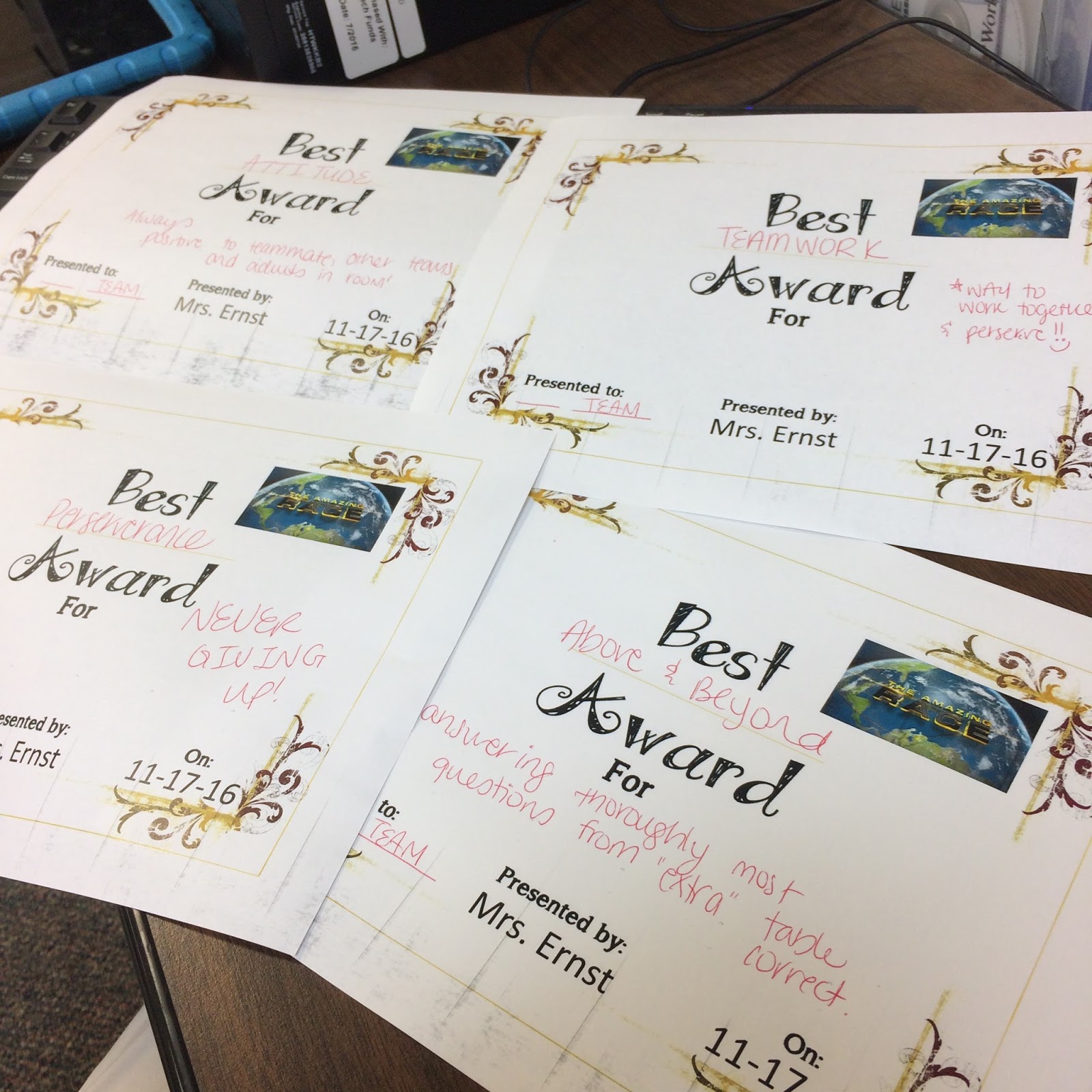
Awards Ceremony:
I called up team colors to receive their books to unwrap for our classroom and some 100 grand bars. Each team got called up and received 2 books at the least and "200 grand". Our top team opened 6 new books for our library and more "grand" than others but each team received "prizes."
We also received some special awards (just special candy - I would have done some medals, whistles, glow sticks, etc... but pregnancy got the best of me and we ended up with special candy from dollar store)
Some of the extra awards are:
Best Perseverance - working hard even through a tough time
Above and Beyond award - answered questions most thoroughly from the extra table
teamwork - worked together even though maybe not fastest but showed courtesy
attitude - kept up good attitude throughout whole race and was positive with teammate and other teams.
Team Spirit - wearing their team colors and making up a handshake or cheer to promote team spirit
We then filled out a google Form to reflect on our learning and after submitting they posted on a Padlet their favorite part from the day!
Here is the link to our reflections questions and Padlet. We used this to help determine our "extra" award winners and reflect on our learning!
Check out these items to make this happen in your classroom:


 since they got to take home 4 different types and that worked out great. The booklet even comes with a whole page of parent extensions!
 combined with sequins to make a winter-y pearl paint. I loved the shimmer and shine but it wasn't too much and the consistency came out just right. We learned no matter how many times we made it that consistency varied each time it seemed like - too loose, too tight or just right. It took lots of trial and error - we used pipettes to drop in the
  solution to make sure we weren't adding too much. Watering down the glue helps as well.
 and
and  in different batches we could test the strength of each. Below is a video of the two different types and how they interacted with
  .
.
 pigment makes this slime so special. The pigment changes color with different temperatures! I could not find one to purchase that changes at a lower temp. Ours changes at 88 degrees Fahrenheit which actually worked out well.

 works better than white glue for glow slime!
 ink in our water since it glows in black lights, we used glow paint and black light paint to make sure our slime glowed in dark and under black light really well. I made sure kids got to see each part of that process as well!


 prizes!


 - our first read aloud) led them to our library where they had a "Road Block" they must read one of the 4 nonfiction books about creepy, crawly, undersea animals and get a 90% above on a comprehension quiz to move on. **4 groups could do at once** they had to show me scores for initials and to move on. (People who don't like AR hide your eyes!!!!)